




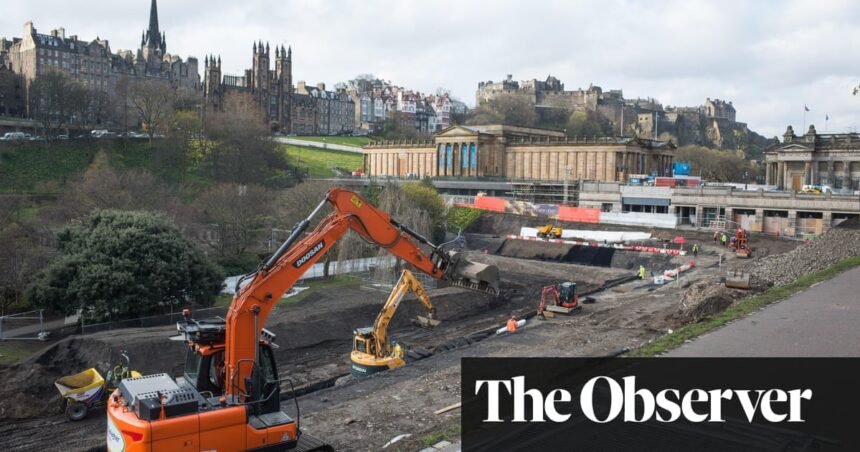
For over 200 years, the origin of Edinburgh’s iconic Mound has been somewhat enigmatic. Constructed in the late 18th and early 19th centuries on the marshy ground of a drained loch, this artificial mound served as a link between the medieval Old Town and the burgeoning New Town, fundamentally reshaping the Scottish capital.
The tale of its creation traces back to the 1770s to a tartan salesman named George Boyd, who, in need of a shortcut over the soggy terrain to access the elegant new developments, laid down stepping stones and planks, forming a path known as Geordie Boyd’s Mud Brig.
Historically, it was believed that residents of the Old Town gradually built up this path by haphazardly dumping household waste alongside earth and rubble from New Town construction sites, eventually leading to the formation of the Mound. However, recent evidence indicates that the town council took a more active role in the meticulous construction of the Mound using local refuse.
Since the land is now recognized as a World Heritage Site, harboring Victorian railway tunnels below and Category A-listed buildings above, archaeologists have had limited chances to verify the accuracy of the well-told origin narrative. Yet, a rare archaeological study conducted during excavation by the National Galleries of Scotland revealed a surprising lack of household waste, food, or organic materials.
Instead, findings by Addyman Archaeology suggest that the town council organized the disposal of specific types of waste—ceramics, oyster shells, clay pipes, glass, tiles, bricks, and other construction debris—into well-managed deposits, methodically arranged in designated zones.
Dr. Patricia Allerston, curator at the National Galleries of Scotland, noted, “It would have been in the council’s interests to ensure the rubbish laid down was clean waste – so non-organic matter. It must have been quite an operation. So it must have been regulated in some way.” The new evidence points to a controlled process of waste deposition on the mound, with designated routes for specific materials.
Both 17th and 18th-century bricks were uncovered, indicating some of the rubble originated from demolition sites in the Old Town. These discoveries offer insights into Edinburgh’s historical development, revealing that as the city expanded, thoughtful planners sought to encourage residents and builders to efficiently repurpose and recycle waste. “The surprise of this study was that it showed civic organization perhaps earlier in this area than anticipated,” Allerston remarked.
Art historians have been able to reexamine contemporary artworks related to the Mound displayed in new galleries, informed by these recent findings. For instance, Alexander Nasmyth’s painting, Edinburgh Castle and the Nor’ Loch, captures a scene where a man appears to tip a cart into the loch near the castle, accompanied by others who seem to be officials.
Traditionally viewed as a nostalgic representation since the loch had been drained by the time Nasmyth painted it, Allerston now believes the artist was depicting the city’s transformation. Rather than merely lamenting the past, he was engaged with the dynamic changes occurring in the city, illustrating the official processes that were reshaping Edinburgh.


